Monday, January 4, 2016

Machu Picchu

Peru for winter break – December 2015 to January 2016!  This was a special trip  because Christina's parents joined us on this adventure.  It was our first time hosting family in one of our overseas cities.
Planning a 3 week vacation is no easy feat, but it all worked out thanks to Agoda, Copa Airlines, and Kuoda Travel.

We flew into Lima, then flew to Cusco (11,500' elevation), took a train to Machu Picchu (7,800') then back to Cusco to depart on a bus ride down to Lake Titicaca (12,500').  Then a flight to Lima to return to Panama.  Whew!


Cusco and the outlying areas have several examples of Inka architecture using perfectly set stones, some as large as 15' weighing a few tons.


This stone is very special because it has 9 adjoining stones perfectly set along its outer edge.  This stone is 12' high.


Here's a photo that provides some scale.


We wanted some local cuisine and were taken to this place in Cusco.  You can order the cut (guinea pig) which is served full-bodied on a plate, without the fur.  If you don't mind teeny bones, then buen provecho!  I'll spare you our photos. 


We spent the night in a town 2 hours outside Cusco, called Urubamba then took the viewing train to Machu Picchu.


The train winds along the river and the windows on top of the train car allow you to see the towering Andes mountain tops above.


I just happened to have a pin in my Swiss Army knife and I could not fit it between the stones.


The sprawling 15th century Machu Picchu has such beautiful views, which can be seen through various windows built into the structures.  Before you go there, you should walk up and down 15, 000 steps to prepare for the tour of this world heritage site.

I planned an extra day in Machu Picchu so we could walk up to the Sun Gate to get another view of Machu Picchu from an even higher vantage point.  The entire area has an energy that can be felt when you sit and soak in the surrounding peaks, with the stunning drop down to the U-shaped Urubamba river below.


Llama roam the grounds freely ...


...and make the photos even more interesting.


Driving from Cusco to Puno (Lake Titicaca), we briefly stopped at the highest point to view the Andean glaciers.


The alpaca love this weather!


14,419 feet above sea level!!


Once at Lake Titicaca, we took a cruise on this, the highest lake in the world, to visit the floating homes of the Uros.  The boats, homes, and the foundation are all made of reeds.


We managed to get about 20 people on this reed boat and it was very sturdy.


We cruised over to Taquila Island for views of the mountains of Bolivia and a nice lunch.  Even though the water was calm, there were some rough waves on the other side of the island.


Back in Lima, we had a chance to explore the cathedral and historic parts of the city.  Near our hotel, there was a park with hundreds of cats and some delicious street treats!  The cliffside restaurants are also great for views of the Pacific Ocean.

On the next visit to Peru, we'll go to the Nazca lines, for sure.

Friday, October 2, 2015

First Time on South American Continent

In October 2015 we had a week-long break and though we'd head down to Bogotá, Colombia for our first dip onto the South American continent.  Some of our colleagues at the MET are from there, so we got some good tips on what to do, including trying the ceviche and tamales.


Started in 1807, the Cathedral of Bogotá is at the top of the central square in the old part of the city known as La Candelaria near our hotel.  There is a free walking tour that visits all the historic buildings in the area.  The stormy weather made for some great photos.


A visit to the Botero Museum to see works such as "Mona Lisa" by Fernando Botero, a Colombian artist born in Medellín.  His style is recognized by the oversized, plump forms of people, animals, fruit, and everyday objects (like forks).  We've seen his sculptures in Singapore, too!


North of Bogotá is a salt mine that was converted into a cathedral in Zipaquirá.


The salt mine still produces thousands of tons of salt each year, but the well-lit cathedral hosts thousands of tourists each month.


We decided to take the train to the salt mine cathedral.  There was a live, four-piece band, fresh coffee (tinto) and Colombian treats.  On the way back, we had a full 3-course lunch for $1.25 at a small town near the salt mine.  It was very affordable in Bogotá.


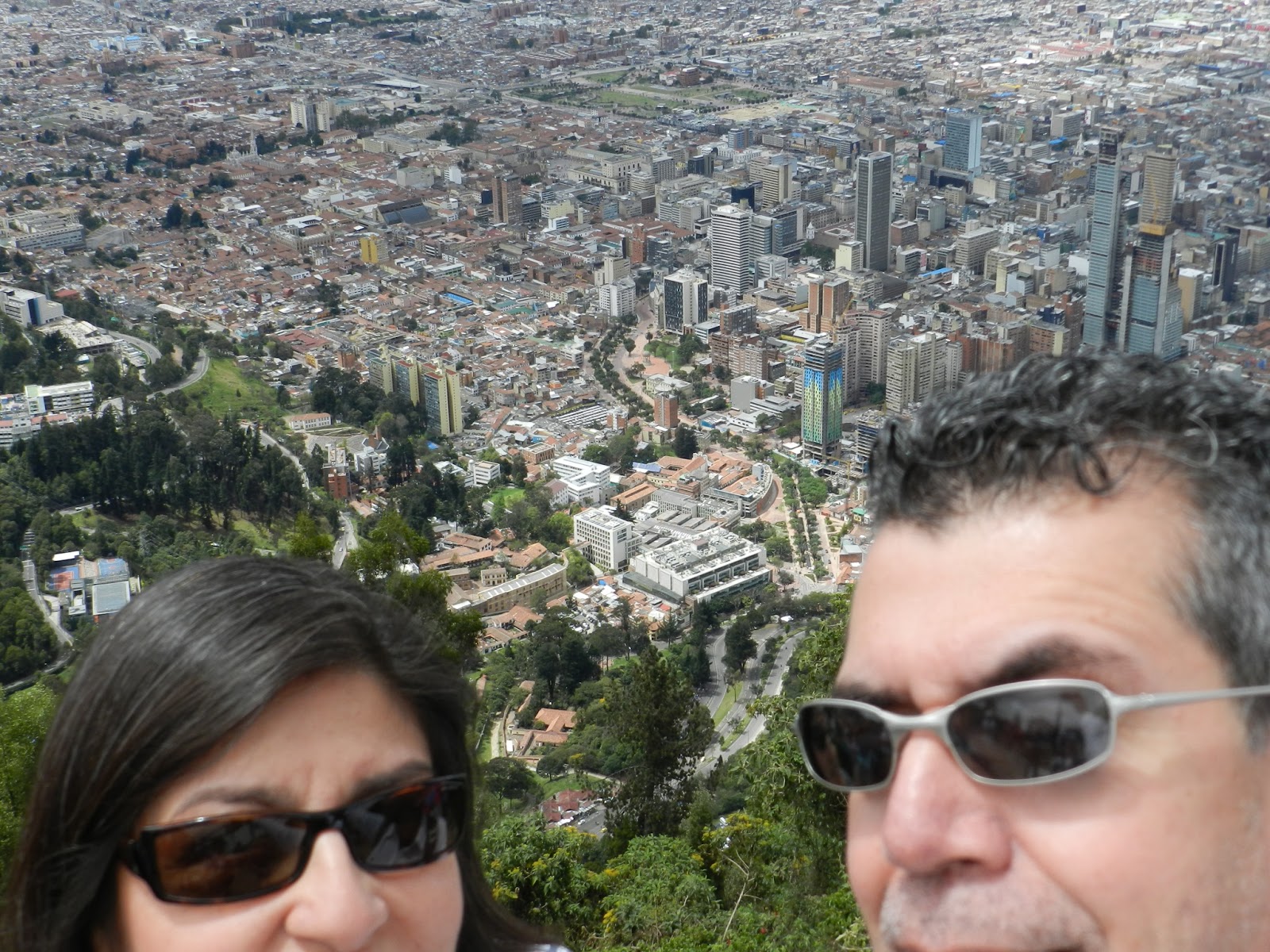
Bogotá is 8,675 above sea level, so it was chilly.  We went up a little higher by taking the funicular to the top of Monserrate, the mountain that overlooks the city.  From there you can see the entire city all the way to the other mountain ranges.


Near the old city, there is a long pedestrian street, about 15 blocks, and there are chess players, vendors of all sorts, and this guinea pig game.  You put your money on top of the bowl that you think the guinea pig will enter and split the profits with the house.  The guinea pig starts about 15 feet away and is prompted to approach the bowls by the game master.


A short stop for lunch at Nana's during one of our walks in the city allowed us to order this humongous avocado.  It's larger than two fists and much more delicious than a knuckle sandwich.  The tamale is also very good, and just as large, so you'd better be hungry.


Getting a view of the city from atop a mountain.


We also visited the most visited museum of pre-Colombian gold artifacts.  It is astonishing to see so much gold on display.


This bird sculpture by Botero has some significance, which you will see in a future post.


Wow!  So much to do.  As far as transportation, you should take the bus everywhere.  There are dedicated lanes and they run early and late.  Taxis are also very safe and have a meter.

Note: Our computer crashed soon after the trip and all of our photos were potentially locked in our damaged hard drive.  Thanks to Illume Solutions in La Habra, California, they were able to recover our photos and other data.  Thanks, John!

Tuesday, September 1, 2015

Signs and Wonders of Panama

Have you seen street signs like these before?


Ahhh, a water fountain that has a bottle refill feature!  This is at the Plaza in the Ciudad del Saber (City of Knowledge) where our school is located.

Beetles almost as big as bananas (guineo is banana down here)!  The jungle allows our insect friends to grow mighty large.


The currency here is the Balboa, B/., or the US dollar as we know it.

In my Panama hat, it's nice to lend a hand down at the Canal.


The Ciudad del Saber used to be Clayton Fort when the US controlled the Canal.  This gas pump is left over from those days and currently resides at a shuttle bus stop.


Down at the Miraflores Locks, which are the first locks from the Pacific Ocean, we saw some ships passing through.


Larger ships are guided through by a mulas, an electric locomotive, tethered to each end of the ship.


Enjoy this timelapse, taken from the 3rd floor of our school, of a couple of ships going through the Miraflores Locks.


Saturday, August 1, 2015

Heading to Central America

After spending several years in Asia (Shanghai, Singapore, and Bangkok), we will be heading to Central America!  We will be working at the Metropolitan School of Panamá.  We will begin new teacher training on August 3rd, 2015 and look forward to joining the wonderful staff at the MET!

Panama's National Anthem


The Metropolitan School of Panama School Anthem


If you haven't listened to any Panamanian music, here's your chance!


What will I be teaching?
With the help of my Art History and History degree from UCLA, I will be teaching Humanities (Individuals and Societies), and an Elective class.  This is a great opportunity to utilize all of my skills as a teacher, artist, traveler, and humanitarian.  UPDATE: in December 
2015, I transitioned to teaching Design.


How can you get to Panama?

We took COPA Airlines from LAX.  American, United, Delta and Aeromexico also fly here.  During July, August, and December, there are restrictions on extra luggage.  From LAX it takes 6.5 hours on a direct flight.  If you sail through the Panama canal, be sure to let us know!